
Covering college football from the sideline requires more than a fast camera and a long lens. It demands disciplined positioning, anticipation, technical control and a postgame workflow capable of turning hundreds of split-second decisions into a clear visual record. At Idaho State’s 29–17 victory over Utah State on Sept. 5, 2026, at Maverik Stadium in Logan, Utah, those demands unfolded across a game defined by defensive pressure, five field goals from Mason Lindberg and a late Idaho State surge.
The final score provides the framework. The images provide the texture.
For a sports media organization such as JTS Media, the assignment is not simply to photograph the winning play. It is to document the full competitive arc: the pre-snap tension, the collision at the line, the pursuit in space, the reaction after the whistle and the tactical details that help viewers understand how the game developed.
That is the purpose of professional sports media coverage. A strong gallery does not merely show that a game happened. It shows how the game felt.
Preparation Begins Before Kickoff
A successful college football assignment starts well before the first snap.
Credentialed photographers must understand the venue’s access rules, designated shooting areas and safety expectations. The sideline is a working environment shared by athletes, coaches, officials, trainers and media personnel. Staying behind the marked media boundary, keeping equipment clear of the field and maintaining awareness of approaching plays are essential parts of the job.
Positioning also requires football knowledge. A photographer must track the line of scrimmage, recognize down-and-distance situations and anticipate where the next meaningful action may occur. A drive approaching the red zone can change the preferred shooting angle. A third-down passing situation may call for a different position than a short-yardage run. The best location is rarely static.
The technical preparation is equally important. Long telephoto lenses provide reach across the field, while shorter zooms can be useful for sideline action, celebrations and contextual images. A monopod can support a heavy lens without sacrificing mobility. Two camera bodies help reduce the need to change lenses during live action and provide a measure of redundancy in a fast-moving environment.
The goal is to begin the game prepared for changing light, changing field position and changing storylines.
Anticipation Separates a Snapshot From a Football Action Shot
Football moves too quickly to be photographed reactively.
By the time a photographer sees the most obvious moment, it may already be gone. The work depends on reading the play before it develops: identifying the likely ball carrier, watching blocking patterns and keeping the focus point where the action is expected to arrive.
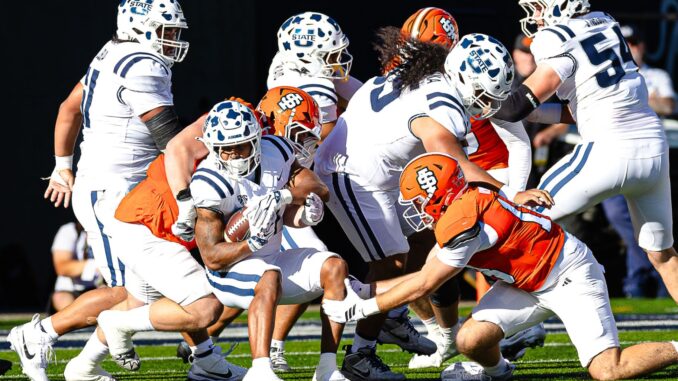
That anticipation is visible in a frame showing an Idaho State runner carrying the ball through a crowded Utah State front. The image is not only about the runner. It includes the surrounding blockers, defenders and field markings, giving the viewer a sense of pressure and forward movement.
A professional sports photographer also has to decide what to exclude. The objective is to keep the primary subject dominant while retaining enough context to explain the play. A wide aperture can help separate an athlete from a busy background, but the composition still needs to preserve the ball, opposing player and direction of movement whenever possible.

An Idaho State ball carrier protects the football as a Utah State defender closes in during the Sept. 5 matchup at Maverik Stadium.
Focus and shutter speed are central to the assignment. A fast shutter speed is typically required to freeze a tackle, cut or catch, while continuous autofocus helps track a moving subject through traffic. Burst shooting can record several stages of a play, but indiscriminate shooting creates a heavier editing burden. The most effective approach balances speed with judgment.
The photographer is constantly making decisions: hold the frame, follow the ball, widen for context or prepare for the next phase of the play.
The Game’s Story Is Larger Than the Score
The Idaho State–Utah State matchup offered several storylines for a photographer to follow.
Idaho State won 29–17 despite Utah State briefly taking a 17–16 lead in the third quarter. Idaho State then scored the final 13 points. The Bengals also intercepted four passes, while the official detailed box score recorded 241 total yards for Idaho State and 407 for Utah State.
Mason Lindberg’s kicking performance added another layer. He made five field goals from 28, 48, 25, 43 and 41 yards, accounting for all 17 of Idaho State’s points.
Those details influence the visual assignment. A game shaped by field goals calls for more than touchdown imagery. A complete gallery should include line-of-scrimmage battles, defensive pressure, passing formations, coverage, kicking situations and the changing body language of both teams as the score shifts.

Players from Idaho State and Utah State meet at the point of contact during a physical sequence from the game.
The camera cannot photograph a statistic directly, but it can document the moments that give statistics meaning. Four interceptions become more understandable when the gallery includes quarterbacks under pressure, defensive backs contesting receivers and players reacting after a turnover. A field-goal-driven game becomes more complete when the visual record includes the tension surrounding a scoring opportunity and the athletes competing between the 20-yard lines.
This is where sports journalism and sports action photography intersect. The work must be visually compelling while remaining faithful to the event.
Working in Available Light
College football may begin in bright afternoon conditions and continue under stadium lights. That transition changes exposure, color and autofocus performance.
In direct sunlight, the challenge may be managing harsh contrast between illuminated uniforms and deep shadows. As evening arrives, the photographer must preserve shutter speed while allowing the camera to work with less available light. Higher ISO settings may become necessary, and white balance must remain consistent enough that team colors look natural across the gallery.
The goal is not to make the scene look artificial. It is to preserve the intensity of the environment with accurate color, crisp detail and controlled contrast.
A tight frame of a tackle can communicate force through posture and facial expression. A wider frame of Utah State’s offense setting up behind the line communicates structure and strategy. Both approaches are necessary.

Utah State’s quarterback prepares to deliver a pass as the offense works from the pocket against Idaho State.
Editing Turns Hundreds of Frames Into a Coherent Story
The assignment does not end when the final whistle sounds.
A college football photographer may return with hundreds or thousands of frames. The first task is to eliminate technical misses: images that are out of focus, poorly timed, obstructed or redundant. The next step is to identify the frames that best represent the game.
Selection should consider variety as well as quality. A useful gallery may include:
- A strong opening image that establishes the matchup and atmosphere
- Clear football action with the ball or decisive contact visible
- Defensive plays, including pressure and coverage
- Offensive formations and moments of execution
- Emotion, reaction and the physical aftermath of a play
- Wider images that place the athletes inside the stadium environment
The edit should also reflect the game’s chronology. The gallery can move from early action to pivotal sequences, then to the closing moments. It should not feel like a random collection of isolated plays.
Captions and metadata add another layer of accuracy. Teams, event date, venue and verified player information should be recorded carefully. When a player’s identity is not confirmed, the responsible approach is to use a descriptive caption rather than guess.
That standard matters to sports publications, athletic programs and brands that may reuse the images. Professional-grade imagery is valuable, but professional-grade accuracy is just as important.
Timely Delivery Without Sacrificing Accuracy
Modern sports media coverage operates on a compressed timeline. Fans, teams and publications may need images while the game is still being discussed online.
A practical workflow is built around four stages: ingest, cull, edit and deliver. During a break or shortly after the game, a photographer can begin transferring files, applying baseline metadata and identifying the strongest early selections. A small group of polished images may be delivered quickly, followed by a more comprehensive gallery and written recap.
Speed, however, cannot replace verification. The final images must be sharp, properly exposed and captioned with information that can be supported. That combination: timely publication and dependable reporting: is central to JTS Media’s approach.
The company’s coverage extends across major sporting venues and competitive environments, including college football, Pac-12 and Big Ten conference events, high school athletics and extreme sports. Each assignment presents different access requirements and visual challenges, but the standard remains consistent: capture the pivotal moment, preserve the surrounding context and deliver the work while the event is still relevant.

An Idaho State receiver reaches for the football near the sideline during the Bengals’ win over Utah State.
Building a Gallery That Lasts Beyond Game Night
The strongest football galleries serve more than immediate reaction. They become part of an archive.
A single image can preserve the intensity of a tackle. A sequence can show how a play unfolded. A carefully edited collection can document the tactical and emotional progression of an entire game, from the opening snap through the final defensive stand.
That is why sideline coverage requires both technical discipline and editorial judgment. The photographer must be ready for the obvious moment while remaining alert to the overlooked one: a defender closing space, a quarterback reading pressure, a receiver securing the ball or a lineman creating the opening that makes the play possible.
At Maverik Stadium, Idaho State’s 29–17 win over Utah State supplied all of those layers. The Bengals’ five made field goals, four interceptions and late 13-point run shaped the result. The photographs preserve the effort, contact and concentration that made those numbers possible.
For fans, athletes, athletic departments and media outlets, that visual record is the enduring value of sports event photography: a timely, accurate and high-quality account of competition at full speed.
View the complete Utah State vs. Idaho State photo gallery, and read JTS Media’s game coverage for the full statistical context.
Leave a Reply