
By Laura Strother
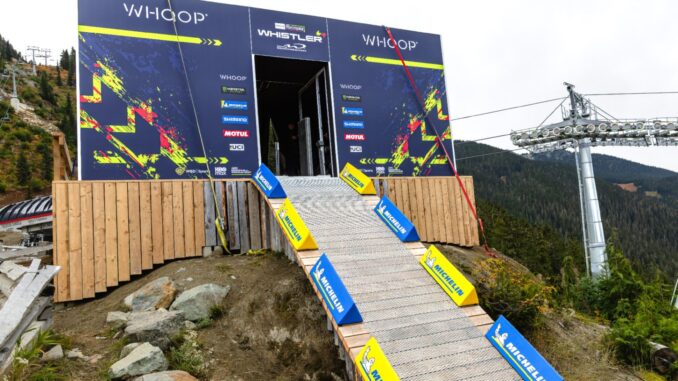
WHOOP start structure and Michelin start ramp on the 1199 course. Credit: Jason Strother / JTS Media
Whistler Mountain Bike Park’s Creekside Zone opened its World Cup chapter Thursday, September 24, as teams and riders completed trackwalk on the famous 1199 downhill track ahead of the WHOOP UCI Mountain Bike World Cup, scheduled for September 25–27, 2026. For some competitors, the inspection marked their first look at the venue since Whistler is hosting a UCI Downhill World Cup for the first time.
The trackwalk provided the first formal opportunity for the field to study the World Cup course before bikes take to the mountain. With qualifying and finals still ahead, no results were established Thursday. Instead, teams focused on gathering information that will shape every training run, line choice and race strategy throughout the weekend.
Trackwalk Sets the Competitive Foundation
In downhill racing, trackwalk is a technical preparation period rather than a ceremonial preview. Riders inspect the course on foot, examining the terrain and identifying the lines they may use when they return at speed.
The process allows competitors to study:
- Entry and exit points through technical sections
- Rock slabs, steep chutes and forested terrain
- Braking zones and areas where speed must be carried
- Sightlines approaching jumps, drops and transitions
- Surface changes that may affect traction and control
- Sections where alternate lines could produce an advantage
The objective is to build a mental map of the course before the stopwatch becomes the central factor. On a track as demanding as 1199, a rider’s understanding of the terrain can be as important as raw speed.

Trackwalk on a freshly cut turn. Credit: Jason Strother / JTS Media

Trackwalk on a steep groomed section. Credit: Jason Strother / JTS Media

Riders and staff gathered on a rooty embankment. Credit: Jason Strother / JTS Media

Trackwalkers on a rock slab. Credit: Jason Strother / JTS Media

Wooden bridge drop on the 1199 course. Credit: Jason Strother / JTS Media
The inspection also matters to sports journalists, photographers and media crews. Trackwalk helps media professionals understand the sequence of the course, recognize locations where decisive moments may develop and identify safe, permitted positions for coverage. For action sports photography, that preparation is essential. A photographer must anticipate where riders may compress into a turn, launch from a feature, absorb rough terrain or emerge from the forest at race pace.
JTS Media’s approach to downhill coverage combines that preparation with professional sports photography and timely reporting. The goal is to document not only the result, but also the intensity, technical precision and human pressure that define the run.
Why 1199 Carries Canadian History
The name 1199 honors the 1,199 points Steve Smith earned while winning the 2013 World Cup overall title. Smith became the first Canadian to win the elite World Cup overall, establishing a benchmark that continues to shape the country’s downhill community.
The track’s name therefore connects Whistler’s new World Cup moment to one of the most significant achievements in Canadian mountain biking. The course was developed with the goal of bringing World Cup downhill racing to Whistler, and its debut represents the culmination of years of planning, construction and organization.

The 1199 trail sign. Credit: Jason Strother / JTS Media

Media and teams on the 1199 trackwalk. Credit: Jason Strother / JTS Media
Canadian Cycling Magazine described the event as a homecoming for a generation of riders who developed at Whistler Mountain Bike Park and across the Sea-to-Sky corridor. Finn Iles, one of the leading Canadian riders expected at the event, described the broader significance of the race in direct terms:
“I think it means a lot. It’s a continuation of a legacy that was started with Stevie in terms of showing that a Canadian can be the World Cup champion.”
That legacy now extends to a new generation competing on a track built to test the world’s best downhill racers.
A Demanding Course With a Refreshed World Cup Layout
Official descriptions of 1199 emphasize West Coast loam through pine forests, large rock slabs, steep technical sections and a descent that moves deep into the woods. Canadian Cycling Magazine has characterized the course as steep, with a flat middle sprint and technical terrain that can punish mistakes.
A refreshed World Cup layout has introduced changes to key sections, new higher portions of the track and a large new finish step-down. Those revisions mean the course riders encounter this weekend is not simply a repeat of an earlier race configuration.
The updates were publicly previewed after Danny Hart and Lucas Cruz tested the revised track. Canadian Cycling Magazine reported that trail crews had added new features, modified several important sections and created the large new step-down near the finish. The changes increase the importance of trackwalk because teams must separate familiar terrain from the sections that require new calculations.

The 1199 step-down. Credit: Jason Strother / JTS Media

Freshly shaped berm on the 1199 layout. Credit: Jason Strother / JTS Media

A rutted chute on the 1199 course. Credit: Jason Strother / JTS Media

Rider interviews during trackwalk. Credit: Jason Strother / JTS Media

Studying a steep chute from above. Credit: Jason Strother / JTS Media

A steep dirt chute on the 1199 course. Credit: Jason Strother / JTS Media
Riders must determine how much speed to carry into each feature, where to settle the bike and how to connect the course’s fast and technical segments without losing momentum. The flat middle sprint creates a distinct contrast with the steep sections above and the technical terrain that follows.
Jackson Goldstone, a leading Canadian rider expected at Whistler, has previously assessed 1199 as one of the most challenging tracks on the World Cup circuit. His reported pre-event description highlighted the course’s steep sections, flat middle sprint and “gnarly” technical areas. The assessment underscores the range of demands facing the field: the track requires both explosive speed and precise bike control.
Canadian Riders Prepare for a Home-Course Spotlight
Whistler’s debut creates an unusually strong home narrative for the Canadian contingent. Riders expected or listed for the event include Jackson Goldstone, Finn Iles, Gracey Hemstreet, Lucas Cruz, Bodhi Kuhn, Tegan Cruz, Jakob Jewett, Dane Jewett and Seth Sherlock, among others.
The home setting brings familiarity, but it also increases attention. Canadian riders must manage the pressure of competing in front of supporters while adapting to World Cup-specific changes on a track many know from previous riding and racing.
Goldstone enters the weekend as one of the central figures in the event’s storyline. The Whistler-area rider has deep ties to the mountain and has previously described 1199 as a demanding course. The Jewett brothers, Jakob and Dane, also bring significant familiarity with the venue, having established strong results on the track in earlier competition.

A team group walking the course. Credit: Jason Strother / JTS Media

Riders and staff studying the terrain. Credit: Jason Strother / JTS Media

Riders on the 1199 trackwalk. Credit: Jason Strother / JTS Media

RIDE WRAP banners line a rocky section. Credit: Jason Strother / JTS Media
Iles represents another major Canadian storyline. He has already won twice during the 2026 season, according to Canadian Cycling Magazine, and arrives at a World Cup round that carries historic significance for the country’s downhill program.
Still, familiarity cannot eliminate the uncertainty of a first World Cup race at a new venue. The refreshed layout, international field and pressure of qualifying will determine how much the home-course knowledge ultimately matters.
Overall Standings Add Pressure to the Penultimate Round
Whistler is the penultimate downhill World Cup round of the season, giving the weekend added importance in the overall standings.
According to current pre-race reporting, the elite men’s standings entering Whistler are:
- Jordan Williams: 989 points
- Asa Vermette: 843 points
- Finn Iles: 811 points
In the elite women’s standings, Valentina Höll holds the lead:
- Valentina Höll: 1,455 points
- Harriet Harnden: 850 points
- Lisa Baumann: 817 points
Those figures reflect the standings reported before racing begins at Whistler. They establish the competitive context but do not determine the outcome of the weekend. With training, qualifying and finals still to come, riders will have to manage both the physical demands of 1199 and the championship pressure attached to every split time.

Roots and red tape on the 1199 course. Credit: Jason Strother / JTS Media

Teams inspecting a root-covered section. Credit: Jason Strother / JTS Media

An elevated look at the trackwalk. Credit: Jason Strother / JTS Media

A rock-filled slope on the 1199 course. Credit: Jason Strother / JTS Media
Whistler World Cup Schedule
The official weekend schedule is set in Pacific time:
Friday, September 25
- Training and timed training
Saturday, September 26
- Women Q1, 12:30 p.m.
- Men Q1: 1 p.m.
- Women Q2: 3 p.m.
- Men Q2, 3:30 p.m.
Sunday, September 27
- Junior finals begin, 11:30 a.m.
- Elite women final: 1 p.m.
- Elite men final, 2:10 p.m.

Whistler World Cup event village and finish area. Credit: Jason Strother / JTS Media
Friday’s training will provide the first opportunity for riders to test their trackwalk decisions on bikes. Saturday’s qualifying will establish the final competitive order, while Sunday will deliver the first elite World Cup downhill finals at Whistler Mountain Bike Park.

Teams and media on the tree-lined section. Credit: Jason Strother / JTS Media

Roots and course markings on 1199. Credit: Jason Strother / JTS Media
The official WHOOP UCI MTB World Series Whistler event page and Whistler Blackcomb event information provide the latest venue and event details. Canadian Cycling Magazine’s coverage of the course changes and Canadian rider storylines adds further context to the weekend.

Olympic rings at Whistler. Credit: Jason Strother / JTS Media

The Whistler finish straight. Credit: Jason Strother / JTS Media
Thursday’s trackwalk marked the beginning, not the conclusion, of the competition. The riders have now seen the lines. The next step is determining which ones can withstand World Cup speed.
Leave a Reply